
Night walks keep the schedule sane—especially for busy households, apartments, and working dog owners. But once the sun drops, the risk profile changes fast: cyclists appear out of nowhere, drivers misjudge distance, and a black leash disappears against dark clothing. A light up dog leash is one of those simple upgrades that solves a real problem without changing how you walk your dog.
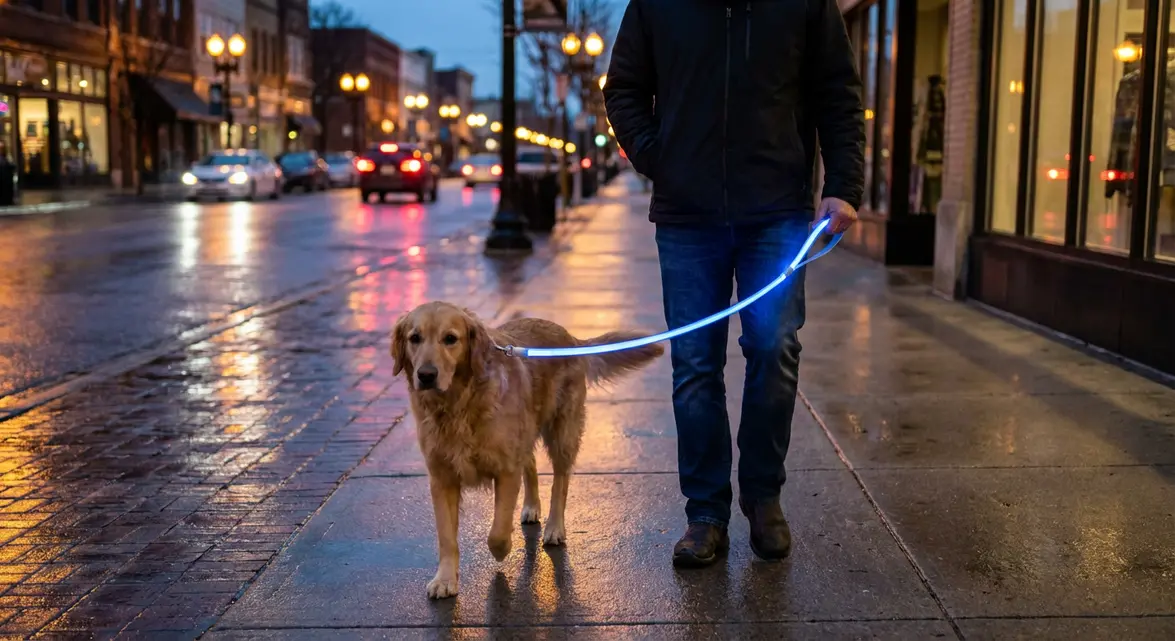
If you sell pet gear, you already know customers don’t buy “LEDs.” They buy peace of mind. They buy fewer close calls. They buy the confidence to step outside at 6 a.m. in winter or at 9 p.m. after dinner. This guide breaks down what makes a light up dog leash worth stocking, what specs matter, and how to choose models that hold up when a 70‑lb Lab decides it’s time to go.
What a Light Up Dog Leash Actually Does (and Why It Matters)
A standard leash controls distance. A light up dog leash controls distance and visibility. That second part is the difference between “I can see my dog” and “a driver can see both of us with enough time to react.”
When a leash glows, it creates a moving, unmistakable line between handler and dog. That line tells a cyclist where to pass, tells a driver there’s a person attached to the animal, and helps prevent the classic trip hazard when someone in the family steps over the leash in a dim hallway or driveway.
For retail and wholesale buyers, that’s the sales hook: fewer surprises at night. The right light up dog leash turns a walk into a predictable, visible routine.
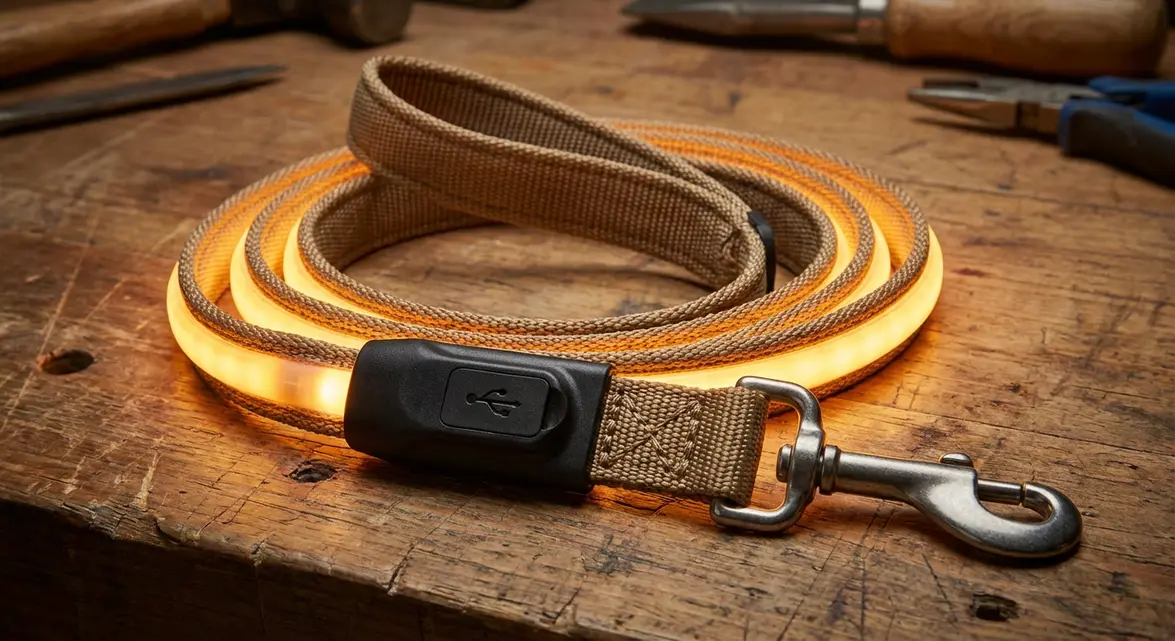
Specs to Look For in a Light Up Dog Leash (Wholesale Checklist)
Not all illuminated leashes are built the same. Some look great in photos and fail in the first month of real use. If you’re sourcing a light up dog leash for your store, focus on these practical specs.
1) Visibility: Brightness, Diffusion, and True 360° Glow
Brightness is obvious, but diffusion is the hidden factor. If the LEDs create “hot spots,” the leash looks bright from one angle and weak from another. A better light up dog leash uses a diffusion layer so the glow is even along the length. Even light reads as higher quality, and it’s easier for drivers to notice.
- Best case: 360° visibility (glow visible from all sides)
- Good: wide-angle visibility with consistent diffusion
- Watch out: thin light strips that only show from one side
2) Battery and Charging: USB Rechargeable vs. Disposable
USB rechargeable is what customers ask for because it’s convenient and cheaper long-term. For you, it’s also fewer returns and complaints. A disposable-battery light up dog leash may sound fine until the first time a customer can’t find the right battery size at 10 p.m. and leaves a one-star review.
What to verify:
- Charging port protection: a covered port reduces moisture and pocket lint issues
- Runtime: real-world runtime matters more than lab claims—look for leashes that last multiple walks per charge
- Charge indicator: simple LED status lights reduce “it won’t charge” tickets
3) Weather Resistance: Why IP Ratings Aren’t Just Marketing
A leash lives outdoors. Rain happens. Snow happens. So does the wet “shake-off” when the dog gets home. If a light up dog leash advertises an IP rating, understand what it means:
- IPX4: splash resistant—fine for light rain, not great for puddles or heavy storms
- IP65/IP66: strong protection against water jets and dust—solid for most climates
- IP67: can survive temporary immersion—this matters when the leash hits a snowbank, a puddle, or gets rinsed clean
From a buyer’s standpoint, higher water resistance tends to correlate with better sealing and fewer dead-on-arrival units after a wet week.
4) Materials and Strength: Nylon, Stitching, and Hardware
“Durable” is vague. What you want is a leash that doesn’t snap, fray, or twist when pulled hard. A dependable light up dog leash usually uses braided nylon or reinforced webbing because nylon handles abrasion and repeated flexing well. That matters when the leash drags across concrete, gets slammed in a car door, or gets tugged 200 times a week.
Hardware matters just as much:
- Clasp: look for a solid metal clasp with a smooth spring action that doesn’t stick in winter
- Swivel: a swivel reduces twisting—less wear on both leash and wrist
- Stitching: reinforced stitching at load points prevents sudden failures when a dog lunges
5) Modes and Controls: Simple Wins
Most customers use two settings: steady-on or slow flash. Too many modes can feel gimmicky, and complicated buttons lead to returns. A good light up dog leash has a button you can find with gloves and a mode sequence that makes sense.
- Steady: easiest to track in traffic
- Flash: grabs attention at crossings
- Memory: returns to last mode (nice but not required)
6) Length and Handling: Comfort for Real Walks
Standard lengths (4–6 ft) cover most use cases, but comfort is what makes people keep using the product. If the handle digs into the hand, customers stop using the light up dog leash and the benefit disappears.
For retail positioning, highlight:
- Ergonomic handle: softer grip reduces hand fatigue
- Traffic handle option: extra control near roads or crowds
- Weight balance: electronics shouldn’t make the leash feel top-heavy
Benefits You Can Sell (Without Overpromising)
Customers don’t need a lecture on lumens. They want to know what changes tomorrow. Here’s what a light up dog leash genuinely improves when it’s built right.
Better Visibility for Drivers and Cyclists
Reflective gear only works when light hits it. A light up dog leash creates its own visibility, which is why it’s so effective on poorly lit streets, trails, and parking lots.
Clearer “Dog Boundary” in Crowds
In neighborhoods with evening foot traffic, that glowing line helps people avoid stepping into the leash path. It’s a small detail that reduces tangles, trips, and awkward moments—especially with kids and strollers.
Less Stress for Owners Who Walk at Odd Hours
Shift workers, early commuters, and winter walkers all end up outside in the dark. A light up dog leash makes those walks feel less risky and more routine. That emotional benefit is why customers come back and buy a second leash.
Fewer “Lost Leash” Moments
If you’ve ever dropped a leash while juggling bags or keys, you know the scramble. A glowing light up dog leash is easier to spot in grass, snow, or the back of a dark car.
A Premium Add-On That’s Easy to Explain
From a shop owner’s perspective, this category is straightforward to merchandise. Pair a light up dog leash with reflective collars, LED harnesses, or safety lights. Customers already understand “see and be seen.” You’re just giving them a cleaner solution.
How to Choose the Right Light Up Dog Leash for Your Customers
Stocking the right products isn’t about carrying the most options—it’s about carrying the options that match real dogs. Use these buyer-friendly groupings when you evaluate a light up dog leash lineup.
For Small Dogs (and Apartment Walkers)
- Lightweight build so the leash doesn’t feel bulky
- Comfort handle for short, frequent trips
- Bright, steady mode for quick visibility in parking areas
For Medium to Large Dogs (Pullers Included)
- Reinforced nylon and strong clasp hardware
- Quality stitching at stress points
- Reliable charging port cover for wet conditions
This is where cheap units fail. A big dog lunging can expose weak stitching in a week. A well-built light up dog leash should handle the sudden load without stretching out or popping seams.
For Trail Walkers and Suburban Streets
- Higher water resistance (look for strong sealing)
- Even diffusion so the leash stays visible from multiple angles
- Longer runtime so it lasts a weekend without constant charging
For Retailers, Groomers, and Trainers
If you’re buying for resale or client packs, consistency matters more than novelty. Choose a light up dog leash with stable manufacturing, clear instructions, and predictable charging behavior. That reduces customer support time and builds trust in your shop.
Common Mistakes (and How to Avoid Returns)
Most negative reviews come from the same handful of issues. If you want the light up dog leash category to stay profitable, plan around these.
- Overstating waterproofing: “water-resistant” isn’t “submersible.” Label it clearly.
- Ignoring hardware: LED tech doesn’t matter if the clasp fails.
- Complicated mode cycling: too many settings frustrate customers.
- Weak diffusion: bright spots look cheap and reduce side visibility.
Frequently Asked Questions
How long does a light up dog leash usually last on a charge?
It depends on brightness and whether it’s steady or flashing. A quality light up dog leash should last multiple walks per charge, not just one short outing.
Is a light up dog leash better than reflective tape?
Reflective tape works only when headlights hit it. A light up dog leash produces its own light, so it stays visible on dim streets and trails even before a car is close.
Can a light up dog leash handle big dogs that pull?
Yes—if the leash is built with reinforced nylon/webbing, strong stitching, and a solid metal clasp. When a large dog lunges, the weak point is usually stitching or hardware, not the LEDs. A well-made light up dog leash is designed to take that load.
What should I look for when buying a light up dog leash in bulk?
Prioritize consistent build quality, reliable USB charging, good diffusion for even glow, and weather resistance that matches your local climate. Those factors keep a light up dog leash selling—and keep returns low.
🚀 Ready to Upgrade Your Pet Safety Gear?
Thank you for reading our guide.
- 🔹 Looking for bulk pricing? Contact our Wholesale Team
- 🔹 Want to see more? Return to Homepage
When you want a simple, practical upgrade that customers understand in five seconds, stock a light up dog leash.