
Night walks sell year-round—winter sunsets, early commutes, and customers who want “one more loop” after dinner. But the risk profile changes fast once the light drops. Cars miss dogs. Cyclists cut corners. A leash line disappears against asphalt. If you stock pet safety gear, you’ve probably heard the same story: “My dog is dark, he blends in.” That’s why a dog light up leash isn’t a novelty item—it’s a practical safety tool you can confidently recommend.
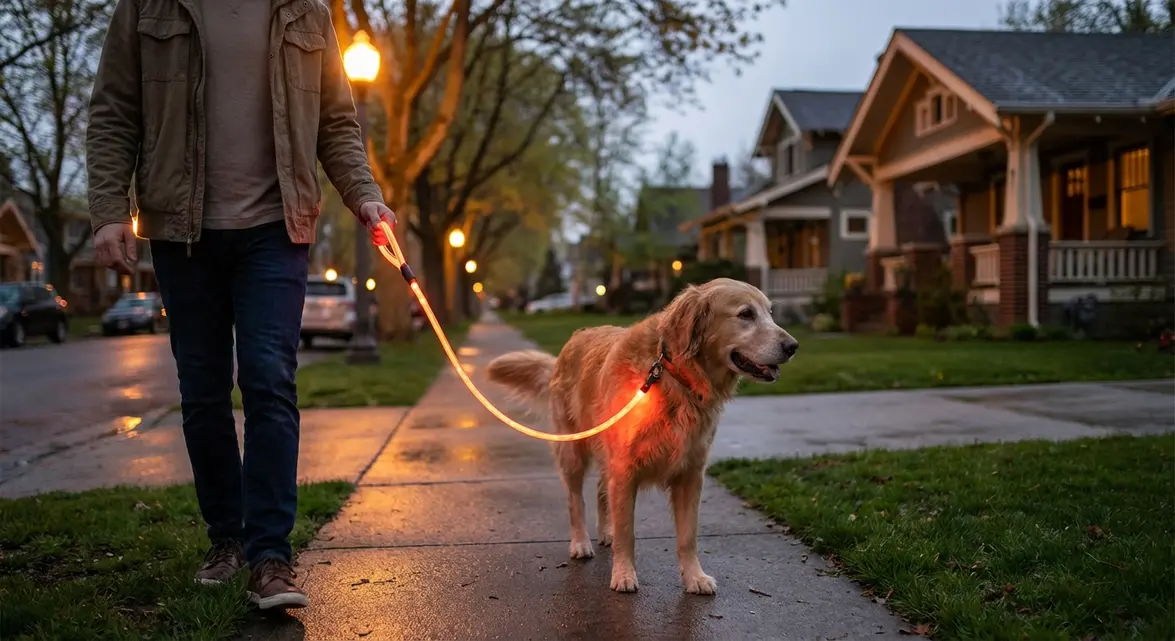
In this guide, we’ll break down what makes a dog light up leash worth carrying, what specs actually matter in the real world, and how to match the right product to the right customer. We’ll keep it grounded: no fluff, just what works when a 70 lb Lab lunges at a squirrel, when it’s raining sideways, or when the leash lives in the backseat all week.
Dog Light Up Leash Specs That Actually Matter
Not all “lighted” leashes are built the same. Some are basically party favors. Others are solid daily-use gear. When you evaluate a dog light up leash for your shelves, focus on the specs below—because they decide whether the product gets five-star reviews or comes back with a complaint.
1) Brightness and Light Pattern (Constant vs Flash)
Visibility isn’t just “does it glow.” A good dog light up leash throws enough light to be seen from a distance and from different angles. Look for:
- Multiple modes (steady, slow flash, fast flash). Customers like flash modes for road crossings and steady mode for park trails.
- Even illumination. Hot spots and dead zones look cheap and reduce visibility when the leash twists.
- Color options. White and green read brightest to the human eye. Red can be useful but may appear dimmer at distance.
Practical note: flash can draw attention faster, but some customers prefer steady for calmer dogs. When you merchandise a dog light up leash, label the modes clearly.
2) Battery Type and USB Recharging
Rechargeable wins in retail because it reduces friction. Customers don’t want to hunt for coin cells at 9 p.m. A dog light up leash with USB charging is easier to explain and easier to keep in rotation.
- USB-C is becoming the expectation; micro-USB still sells but reads dated.
- Runtime matters more than capacity numbers. Shoppers want “how many walks” it lasts, not mAh.
- Charge indicator prevents surprise dead leashes.
For wholesale buyers: ask your supplier for average runtime on steady vs flash. A dog light up leash that lasts 3–5 hours steady is a stronger value proposition than one that looks bright but dies quickly.
3) Waterproofing (What IP Ratings Mean in Plain English)
“Water-resistant” is a marketing word. If you want fewer returns, get clear on protection levels. Here’s how to explain it simply when selling a dog light up leash:
- IPX4: handles splashes and light rain. Fine for quick walks, not for storms or soaking.
- IPX6: handles strong water jets. Better for heavy rain and hose cleanup.
- IP67: dust-tight and can survive short immersion. This is what you want for customers who walk in all weather or have a dog that drags gear through puddles.
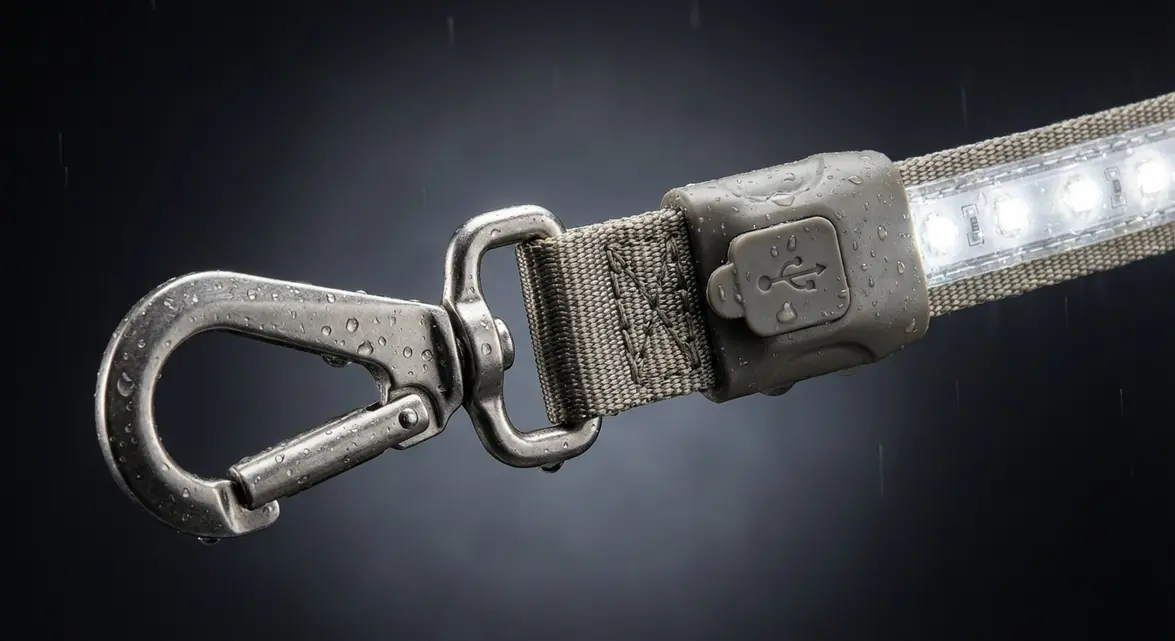
Why it matters: a leaky charging port or poorly sealed LED strip is the #1 reason a dog light up leash stops working early. Waterproofing isn’t a “nice-to-have” in wet climates—it’s the difference between repeat customers and one-time buyers.
4) Leash Strength: Webbing, Stitching, and Hardware
Light features should never compromise the basics. A dog light up leash still has to hold a dog. Look for:
- Nylon or polyester webbing with a tight weave. It resists fraying when it rubs against concrete.
- Reinforced stitching at stress points (handle loop, clip attachment). If the leash fails, it’s almost always here.
- Metal clip quality (spring tension, swivel action). Cheap clips seize up or pop open when a dog spins.
Explain the “why” to shoppers: strong webbing and a solid clip mean the dog light up leash won’t snap when a big dog hits the end of the line. That’s not just inconvenient—it’s dangerous in traffic.
5) Handle Comfort and Control
Retailers often overlook the handle, but customers feel it every day. A better handle reduces complaints. If you can, choose a dog light up leash with:
- Padded grip to prevent rope burn if a dog surges.
- Ergonomic shape that doesn’t dig into the palm.
- Secondary traffic handle near the clip for close control at crosswalks.
The more control a customer has, the safer the walk—especially when the leash is lit and they’re using it in busy areas.
6) Length, Visibility Placement, and Real-World Use
Standard lengths (4–6 ft) are common for a reason. If you go too long, customers lose control near roads. If you go too short, some dogs feel restricted and pull more. For a dog light up leash, the key is where the lighting sits:
- Light along the length improves line visibility so drivers and cyclists see the connection between human and dog.
- Light only at the handle is less useful—nice for “finding your leash,” not as strong for safety.
Benefits of a Dog Light Up Leash (For Customers and For Your Store)
A dog light up leash sells because it solves an obvious problem. But the best way to position it is as part of a layered safety setup—leash visibility, dog visibility, and owner awareness working together.
Better Visibility in Traffic and Crowds
Reflective stitching helps when light hits it. LEDs help when it doesn’t. That’s the simplest explanation for why customers choose a dog light up leash. In practice, it means:
- Drivers see the leash line sooner, especially on unlit streets.
- Cyclists and runners can judge distance and avoid clipping the leash.
- Neighbors can spot the dog and adjust their path, reducing surprise encounters.
Fewer “Near Miss” Moments at Crossings
Crosswalks are where visibility matters most. A dog light up leash makes the human-dog connection obvious—important when a dog is slightly ahead of the owner and a car is turning. Add a lighted collar or harness and the whole team becomes easier to see.
Peace of Mind for Families and Older Owners
Not every customer is an athletic dog handler. Many are parents walking with kids, or older owners who want calm, predictable walks. A dog light up leash helps them feel in control because they can always see where the line is—even if the dog steps behind a parked car or around a trash bin.
Better Retail Story: Functional, Giftable, and Repeatable
From a B2B standpoint, a dog light up leash is a strong category piece because:
- It’s an easy upsell when customers buy winter coats, rain gear, or reflective accessories.
- It’s giftable for new dog owners and holiday shoppers.
- It supports repeat business (matching collar, harness, spare leash for the car).
Merchandising tip: place the dog light up leash near reflective vests, poop bag stations, and rain jackets. Customers already thinking “walk” will add it to cart faster.
Works Best as Part of a “Layered Visibility” Setup
We tell retailers the same thing we tell end customers: don’t rely on one item. A dog light up leash is excellent, but it’s even better with:
- Reflective harness or coat (visibility on the dog’s body, not just the line)
- Lighted collar (keeps the dog visible if the leash is slack)
- Owner light (headlamp or clip-on) so the walker can see hazards and be seen
This framing builds trust and reduces the “I bought it and expected miracles” complaint. The dog light up leash is a piece of a system, and that’s how you sell it honestly.
How to Choose the Right Dog Light Up Leash for Different Customers
One of the fastest ways to reduce returns is to help customers buy the right leash the first time. Here’s a simple matching approach you can use on the sales floor.
For Small Dogs (and Apartment Walkers)
They often need lighter weight, comfortable handles, and easy charging. Recommend a dog light up leash that’s bright but not bulky, and keep the length in the 4–5 ft range for elevator and hallway control.
For Medium-to-Large Dogs (Pullers, Athletes, “Squirrel Spotters”)
This is where strength matters most. A dog light up leash for a strong dog should have reinforced stitching, a durable clip, and webbing that won’t twist into a thin cord under tension. Customers walking bigger dogs also benefit from a traffic handle.
For Rainy Climates and Trail Walkers
Push waterproof ratings and sealed ports. A dog light up leash with stronger water resistance prevents failure after repeated wet walks. If the leash will be tossed into muddy gear bags, durability becomes the selling point, not just brightness.
For People Who “Forget to Charge Things”
It happens. If the customer admits they’re bad about charging, steer them to a dog light up leash with longer runtime and clear battery indicators. They’ll thank you, and you’ll avoid the “it died on the second walk” complaint.
Care, Maintenance, and Shelf-Life Tips
To keep a dog light up leash performing well, customers should treat it like working gear, not a toy.
- Wipe after wet walks, especially around the charging port and seams.
- Charge before long outings and avoid storing it fully dead for weeks (that shortens battery life).
- Don’t machine wash unless the manufacturer explicitly says it’s safe.
- Check the clip for grit; a sticky spring is a safety issue, not just an annoyance.
Retail angle: include a small “care card” or signage near your dog light up leash display. Simple instructions reduce returns and improve reviews.
Common Mistakes Customers Make (and How You Can Prevent Them)
Most negative feedback comes from mismatched expectations. You can head it off with a 20-second conversation.
- Buying for looks, not strength: Remind them the dog light up leash still needs to handle their dog’s pulling force.
- Assuming “water-resistant” means waterproof: Explain IP ratings if you have them.
- Forgetting visibility is a system: Suggest pairing with reflective gear.
- Leaving it charging in extreme heat: Batteries don’t love hot dashboards.
Frequently Asked Questions
Is a dog light up leash better than a reflective leash?
A dog light up leash is usually more visible in low light because it emits light instead of waiting for headlights to hit it. Reflective is still useful, and the best setups combine both.
How long does a dog light up leash typically last on one charge?
It depends on brightness and mode, but many options run several hours. For customers who walk nightly, recommend a dog light up leash with a clear battery indicator and strong runtime on steady mode.
Can I use a dog light up leash in heavy rain?
Yes—if it’s properly sealed and rated for water exposure. If your dog light up leash lists an IP rating like IPX6 or IP67, it’s typically a safer bet for heavy rain than a generic “water-resistant” label.
What’s the safest length for a dog light up leash near roads?
For most people, 4–6 ft is a safe, controllable range. A dog light up leash that’s too long can put the dog into traffic before the owner reacts, even if it’s bright.
🚀 Ready to Upgrade Your Pet Safety Gear?
Thank you for reading our guide.
- 🔹 Looking for bulk pricing? Contact our Wholesale Team
- 🔹 Want to see more? Return to Homepage