
The Ultimate Dog Light Up Harness Guide: Safety & Visibility
When customers ask for nighttime safety, they’re usually thinking “bright” and “easy.” You’re thinking returns, durability, and whether it will still work after a week of rain and a 70 lb dog hitting the end of a leash. A dog light up harness can meet both sides of that equation—if you choose the right build, battery, and fit system. This guide breaks down what actually matters, what to put on your shelf, and how to explain it in plain language at the counter.
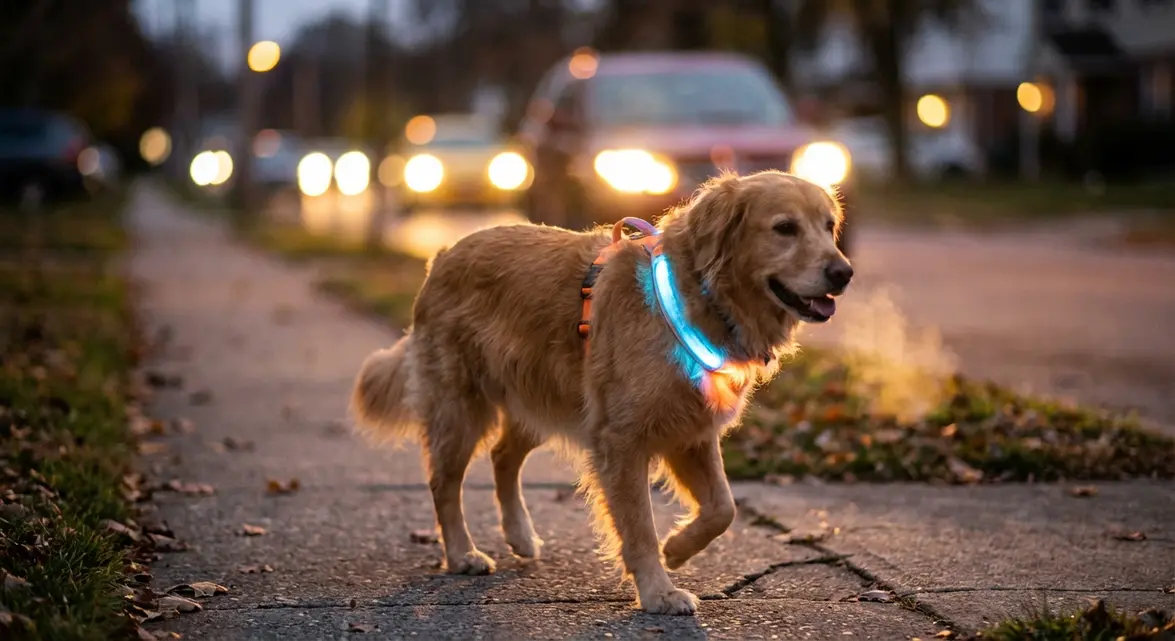
We’ll stay practical: real specs, why those specs matter, and a short checklist you can use when comparing suppliers. If you stock pet safety gear or buy for a grooming, boarding, or training business, this is your playbook for picking a dog light up harness that customers trust and dogs can’t destroy in three walks.
What a Dog Light Up Harness Is (and What It’s Not)
A dog light up harness is a walking harness with built-in LEDs or fiber-optic light piping designed to increase a dog’s visibility in low light. It’s not a replacement for a leash, training, or supervision. And it’s not the same thing as a collar light clipped on after the fact. Integrated lighting tends to sit higher and wider on the dog’s body—so drivers, cyclists, and other walkers see the dog’s shape, not just a single blinking dot.
For many customers, that “shape recognition” is the real win. A harness outline moving along a roadside reads as “animal” faster than a tiny light bouncing near the neck.
Dog Light Up Harness Specs That Actually Matter (and Why)
If you’re verifying a product listing or evaluating a vendor sample, don’t get distracted by buzzwords. These are the specs that separate a good dog light up harness from a dead battery and a disappointed customer.
1) LED placement and visibility coverage
Ask: does the light run across the chest and shoulders, or is it just a small strip on the back? A dog light up harness with 360-degree or near-360 coverage is easier to spot from cross-traffic angles. Back-only lighting is better than nothing, but it’s not ideal for intersections or multi-use trails.
Also check diffusion. If the LEDs create hot spots (bright dots with dark gaps), visibility is less consistent. Diffused light strips or fiber-optic channels spread the glow and look “premium” on the shelf.
2) Battery type, capacity, and real-world runtime
USB rechargeable is table stakes now, but it’s not all equal. Look for:
- Battery capacity (mAh) and a stated runtime per mode (steady, slow flash, fast flash).
- Charge time that matches customer patience—roughly 1.5–3 hours is a workable range.
- Overcharge/over-discharge protection, so the battery doesn’t degrade quickly if someone leaves it plugged in overnight.
Why it matters: customers don’t measure in mAh. They measure in “did it last the whole evening walk?” A dog light up harness that dies mid-walk becomes a return and a bad review, even if it was “bright” for the first 20 minutes.
3) Water resistance (not just “waterproof” marketing)
Rain happens. Dogs roll. People rinse mud in the sink. Look for clear water-resistance language and ideally a test rating (like IPX4, IPX6, etc.). Even without an IP rating, you can assess the build:
- Sealed switch area (or recessed button) to reduce water entry
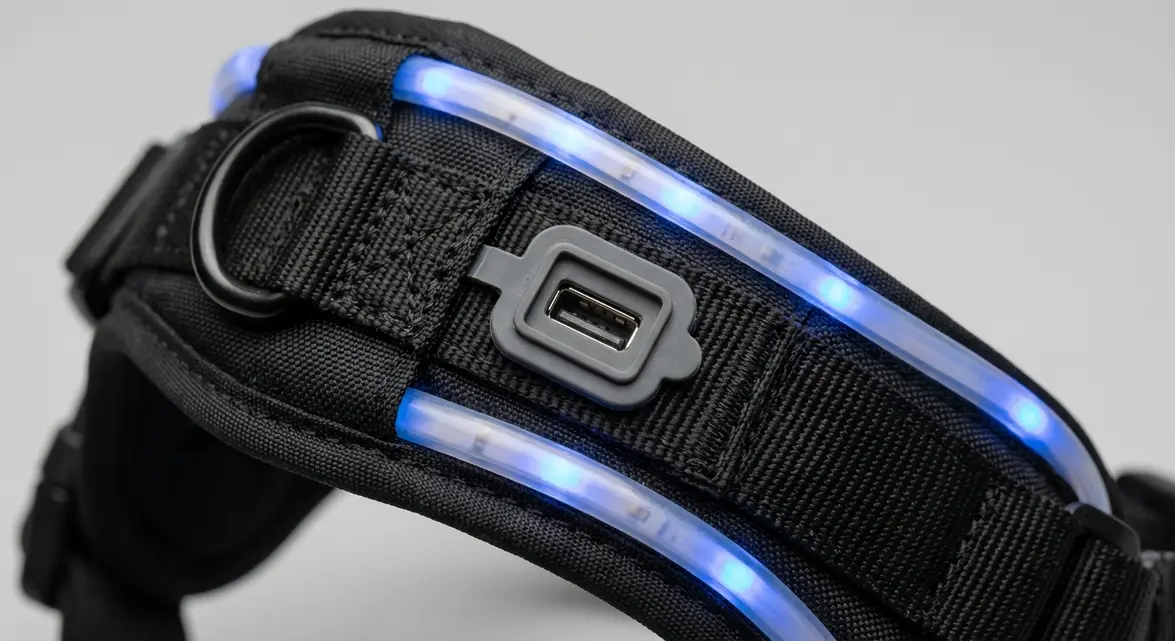
- Protected charging port with a snug rubber cover
- Encapsulated LED strip instead of exposed wiring
Why it matters: a dog light up harness that fails after a drizzle trains customers to distrust the whole category. For shop owners, that’s lost upsell on leashes, reflective gear, and safety accessories.
4) Harness material and stitch quality
Most good units use nylon webbing or a nylon/polyester blend. What you want to confirm is the weight of the webbing and stitch reinforcement at load points (where the D-ring or leash attachment is anchored). Tight box stitching and reinforced bartacks help prevent tearing when a dog lunges.
Why it matters: customers buy a dog light up harness for safety, but they keep using it because it feels secure. If the harness twists, frays, or stretches, it becomes a problem product.
5) Hardware: buckles, adjusters, and leash attachment
Inspect the buckles. Do they feel crisp and secure, or cheap and soft? Metal D-rings should be smooth (no sharp edges) and firmly sewn into webbing that won’t creep. A dual D-ring setup can be a plus for redundancy, but only if the sewing is strong.
Why it matters: a dog light up harness is often used in higher-risk situations—night walks, roadside potty breaks, busy parking lots. A buckle failure at night is the worst-case scenario.
6) Fit system and size range
A harness can be bright and still be a “no” if it doesn’t fit. Look for:
- Multiple adjustment points (neck and chest at minimum)
- Clear size chart with chest girth ranges
- Comfort padding where the strap crosses the chest and underarms
Why it matters: chafing around the armpit is the #1 reason customers stop using a harness. A comfortable dog light up harness gets repeat use—and repeat customers come back to your store.
7) Controls: modes that make sense
Most buyers want simple: one button, three modes (steady + two flash patterns). Avoid products with confusing mode cycles or tiny buttons that are hard to press with gloves.
Why it matters: usability is a selling point you can demonstrate in 10 seconds. A dog light up harness should be easy to operate in the dark, one-handed, while holding a leash.
Benefits of a Dog Light Up Harness (How to Sell It Without Overpromising)
Visibility products can get into exaggerated claims fast. Keep it honest and practical. Here’s how a dog light up harness delivers value in the real world, plus talking points you can use with customers.
More visibility from more angles
Reflective gear only works when light hits it. LEDs create their own signal. That matters on dim streets, in parks, and on trails where there may not be headlights at all. A dog light up harness also helps other dog owners spot your customer’s dog sooner, which can reduce surprise encounters.
Better control than a collar light
Harnesses distribute force across the chest and shoulders. For many dogs, that means less coughing and less neck strain than a collar. When you combine that with lights, you get a single “grab-and-go” piece of gear. A dog light up harness is especially useful for dogs that pull, dogs in training, and older dogs with more delicate necks.
Quick wins for safety-minded shoppers
Customers don’t need a long explanation. If you can show them the button, the charging port cover, and how the straps adjust, you’ve done 80% of the sale. A dog light up harness is a tangible product—people love seeing it glow right there at the counter.
Helps with “where is my dog?” moments
Backyard potty breaks, campsites, dusk at the cabin—these are the situations customers mention after the purchase. The goal isn’t to replace recall training. It’s to make a dog easier to spot. A dog light up harness turns a dark silhouette into a visible moving target.
Pairs well with reflective leashes and ID tags
For upsells, keep the bundle practical: reflective leash, a backup clip-on light for the owner, and an ID tag. When the primary product is a dog light up harness, these add-ons feel logical, not pushy.
Buying Checklist for Retailers and Bulk Orders
If you’re stocking a dog light up harness in volume, you’re not just buying a product—you’re buying fewer headaches. Here’s a quick verification list you can use with any supplier:
- Lighting: bright, diffused, and visible from the side
- Battery: stated runtime per mode; consistent brightness as it drains
- Charging: secure port cover; cable included; clear indicator light
- Water resistance: sealed housing; passes splash/rain use
- Straps: thick webbing; reinforced stitching at D-ring and buckles
- Comfort: padding at chest/underarm; no sharp edges
- Sizing: clear chart; enough adjustability for common breeds
- Packaging: simple instructions (how to charge, wash, and store)
- Support: warranty/defect policy that’s realistic for retail
Pro tip: ask for a sample and do a “bad week” test. Charge it. Soak it with a spray bottle. Leave it in a cold car overnight. Put it on a big puller. A dog light up harness should keep working after normal abuse, not just look good in a product photo.
Care and Handling: Reduce Returns Before They Happen
Most returns come from two issues: charging confusion and water damage from improper washing. A short care card (or a staff script) helps.
- Charging: fully charge before first use; close the port cover firmly.
- Cleaning: wipe down or hand wash; avoid full submersion unless rated for it.
- Storage: don’t store long-term with a dead battery; recharge every few months.
- Fit: two-finger rule; check for rubbing behind the front legs.
When customers understand how to use a dog light up harness, they’re happier and your defect rate stays low.
How to Choose the Right Dog Light Up Harness for Different Customers
One size doesn’t fit all—literally. Here are quick matches that make selling easier.
- City walkers: prioritize side visibility and steady mode brightness. A dog light up harness that reads clearly at intersections is the sell.
- Trail users: prioritize battery life, water resistance, and a secure D-ring. A dog light up harness should handle mud and light rain.
- Small breeds: prioritize lightweight hardware and soft edging. The best dog light up harness for a 10 lb dog won’t feel bulky.
- Strong pullers: prioritize webbing strength and stitching quality. A dog light up harness should hold up when the dog surges forward.
Conclusion: Stock Smart, Sell Confident
Night safety products sell when they’re simple, reliable, and easy to explain. Focus on lighting coverage, runtime, water resistance, and stitching strength—those are the things customers notice after the purchase. If you choose a well-built dog light up harness and teach buyers how to charge and clean it, you’ll cut down on returns and build trust in your pet safety wall. For everyday walks, roadside breaks, and early-morning routines, a dog light up harness is still one of the most practical safety upgrades a dog owner can buy.
Frequently Asked Questions
How long does a dog light up harness typically last on one charge?
It depends on battery size and mode, but most retailers should look for a dog light up harness that can cover at least one to several evening walks per charge. Always check runtime per mode (steady vs. flashing).
Is a dog light up harness safe to use in rain?
A quality dog light up harness should handle rain and splashes if the housing is sealed and the charging port cover fits tightly. For heavy water exposure, look for clear water-resistance claims or testing.
Can I wash a dog light up harness?
Most brands recommend wiping down or gentle hand washing and avoiding full submersion unless the product is specifically rated for it. A dog light up harness lasts longer when the electronics stay dry and the port cover is closed.
Should I choose flashing or steady mode?
Steady is simple and easy to track; flashing can grab attention in busy areas. A good dog light up harness should offer both so customers can match the setting to the environment.
🚀 Ready to Upgrade Your Pet Safety Gear?
Thank you for reading our guide.
- 🔹 Looking for bulk pricing? Contact our Wholesale Team
- 🔹 Want to see more? Return to Homepage